
Give your hair a chance, in as little as 16 weeks, without medication
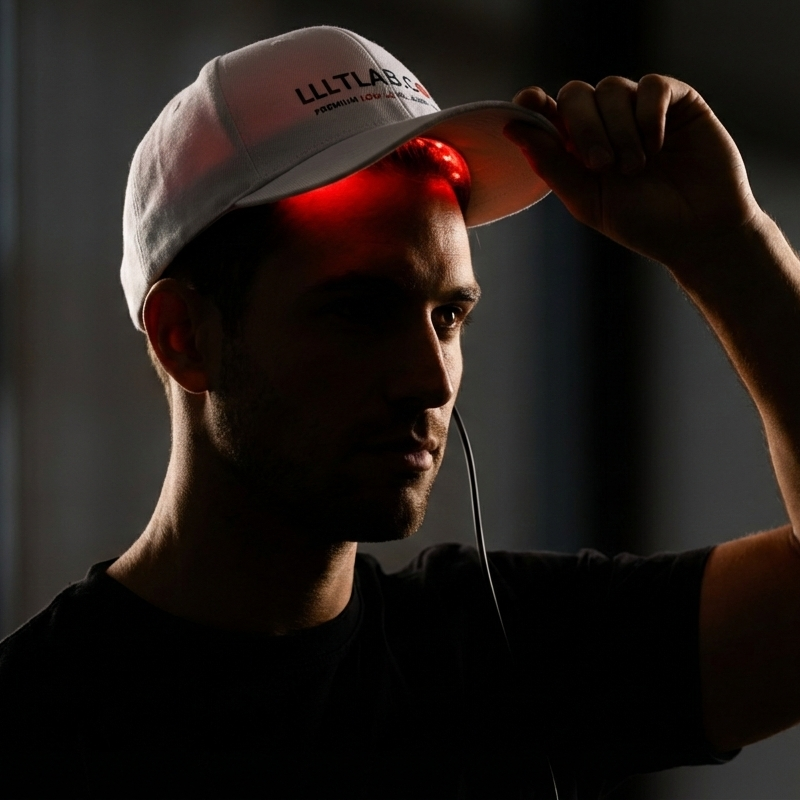
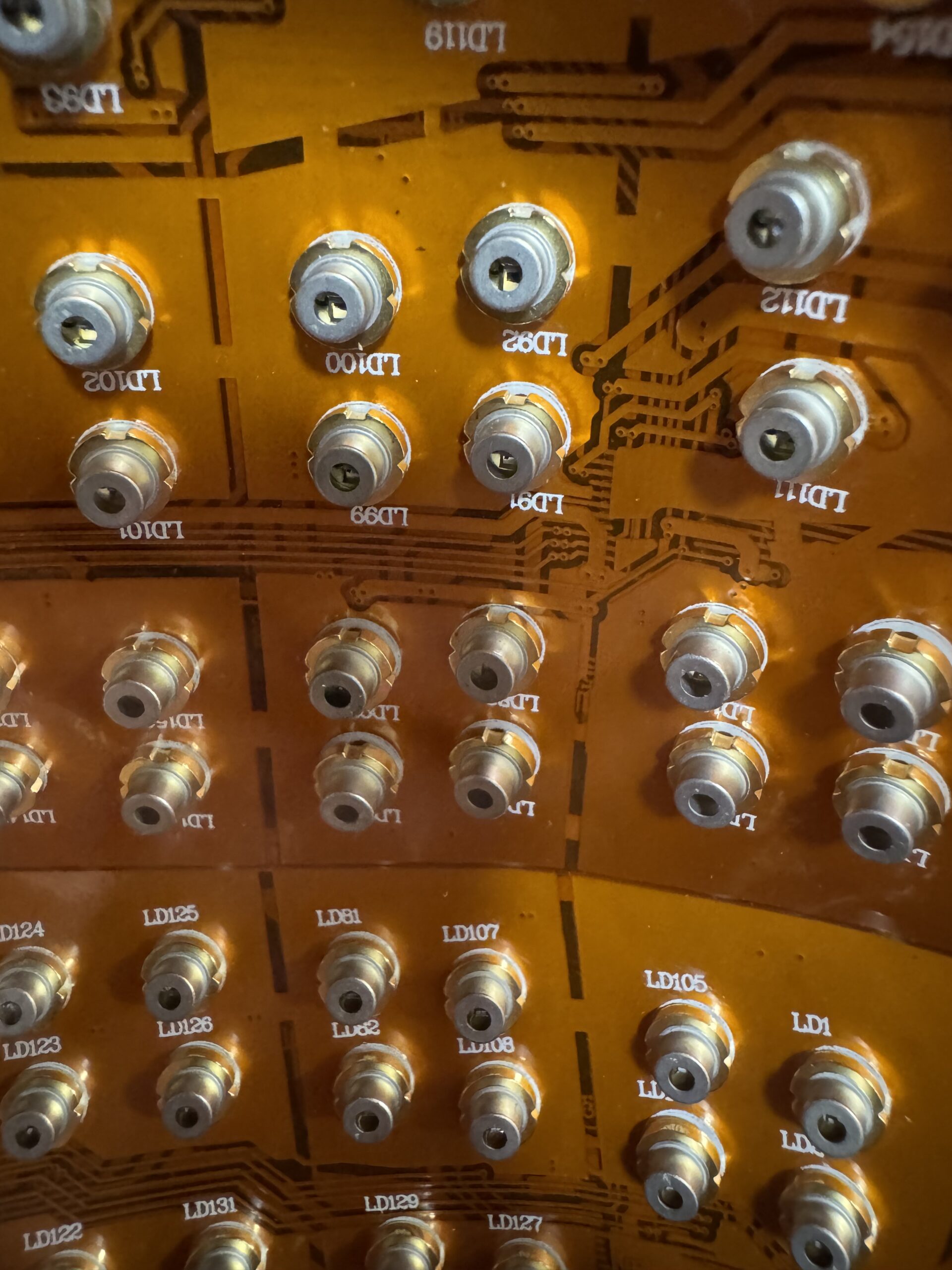
Low-level laser therapy (LLLT) is a scientifically studied method. Real laser diodes, not LEDs.
Researched
technology studied in trials
Real
laser diodes
2 years
warranty
RoHS compliance
Low-Level Laser Therapy
LLLT (Low-Level Laser Therapy) is a non-invasive, painless form of application that directs red laser light at the hair follicles.
How does it work?
LLLT emits red light at a wavelength of 650 nm, which penetrates the scalp. In scientific research this light has been linked to cellular energy production and local circulation.
A number of published studies have examined LLLT alongside hair growth parameters. The reported observations concern the anagen (growth) phase of resting follicles, the length of the growth phase and follicle activity.
Circulation
Supporting the natural circulatory processes of the scalp
Cellular activity
Stimulating processes linked to how cells use energy
Hair cycle
Supporting processes linked to the natural growth cycle of the hair
When is it used?
A device designed for home use in a range of situations involving hair loss.
Male pattern hair loss
For thinning linked to androgenetic alopecia.
Thinning in women
For female pattern thinning, diffuse thinning and finer hair.
Receding hairline
For hair loss beginning at the temples, forehead and crown.
Before and after a hair transplant
Used both before and after a hair transplant. Discuss its use in this case with your clinic.
Thinning hair
For thinning in its early stages, used early.
As a precaution
For anyone with a family predisposition who wants to act early.
Ready to start?
Choose your model →Technology studied in clinical trials
LLLT has been examined in numerous peer-reviewed studies. Below are some published findings from the literature.
Comparative trial
A 2024 randomised controlled trial reported changes in total hair count, hair density and the proportion of terminal hairs under LLLT. Please see the linked paper for the details and its limitations.
Read the study →FDA 510(k) clearance in the USA
In the United States, dozens of LLLT devices have received 510(k) clearance for androgenetic alopecia since 2007. A 510(k) is not an approval but an acceptance that the device is equivalent to one already on the market. It applies to those manufacturers' devices, not to this product.
Read the review →Meta-analysis findings
A 2017 systematic review and meta-analysis assessed randomised trials of LLLT. Please see the linked paper for the details.
View the paper →Safety in the literature
The literature describes LLLT as a low-risk technology. In the studies reviewed, no lasting discomfort was reported in connection with its use.
Safety overview →Choose the right model
All three models use laser diodes only and come with a two-year legal guarantee. The difference is in how much of the scalp they cover.
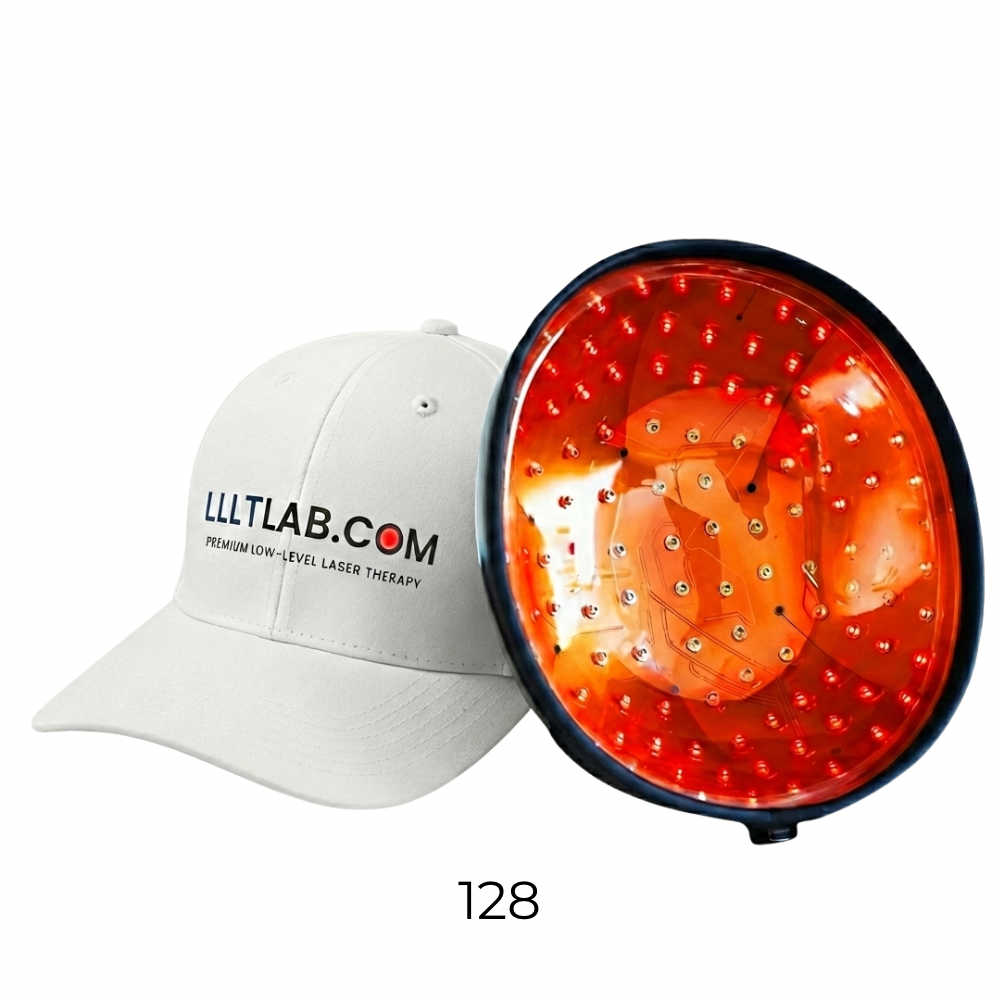
128 diodes
Entry level
One-off price, no subscription
For anyone without pronounced hair loss who wants to try the technology first.
- 128 laser diodes
- 650 nm wavelength
- 30-minute session
- 2-year legal guarantee
- Light and comfortable to wear
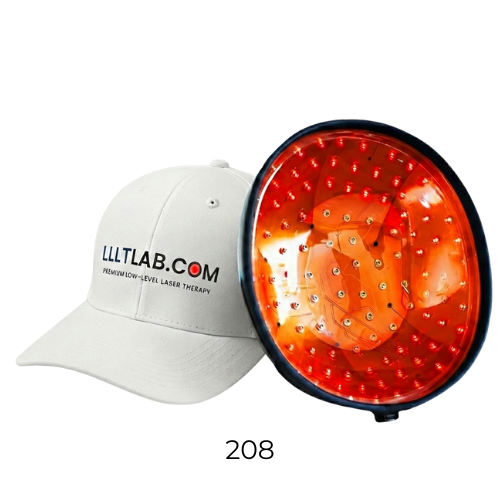
208 diodes
Mid range
One-off price, no subscription
For early signs, or a family predisposition, where you want to act in good time.
- 208 laser diodes
- 650 nm wavelength
- 30-minute session
- 2-year legal guarantee
- Better coverage
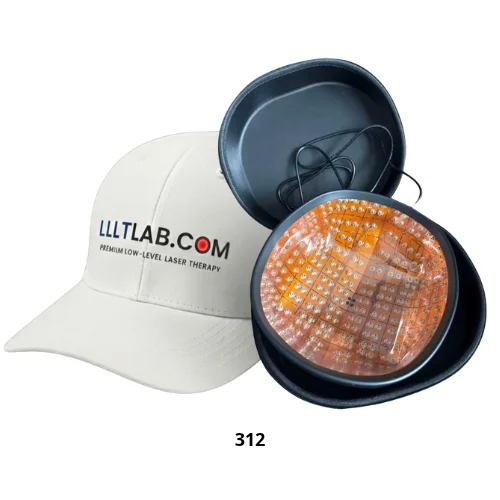
312 diodes
Top of the range
One-off price, no subscription
For anyone who wants the widest possible coverage of the scalp. The model with the highest diode count in our range, for use at home.
- 312 laser diodes
- 650 nm wavelength
- 30-minute session
- 2-year legal guarantee
- Maximum coverage
- Highest diode count
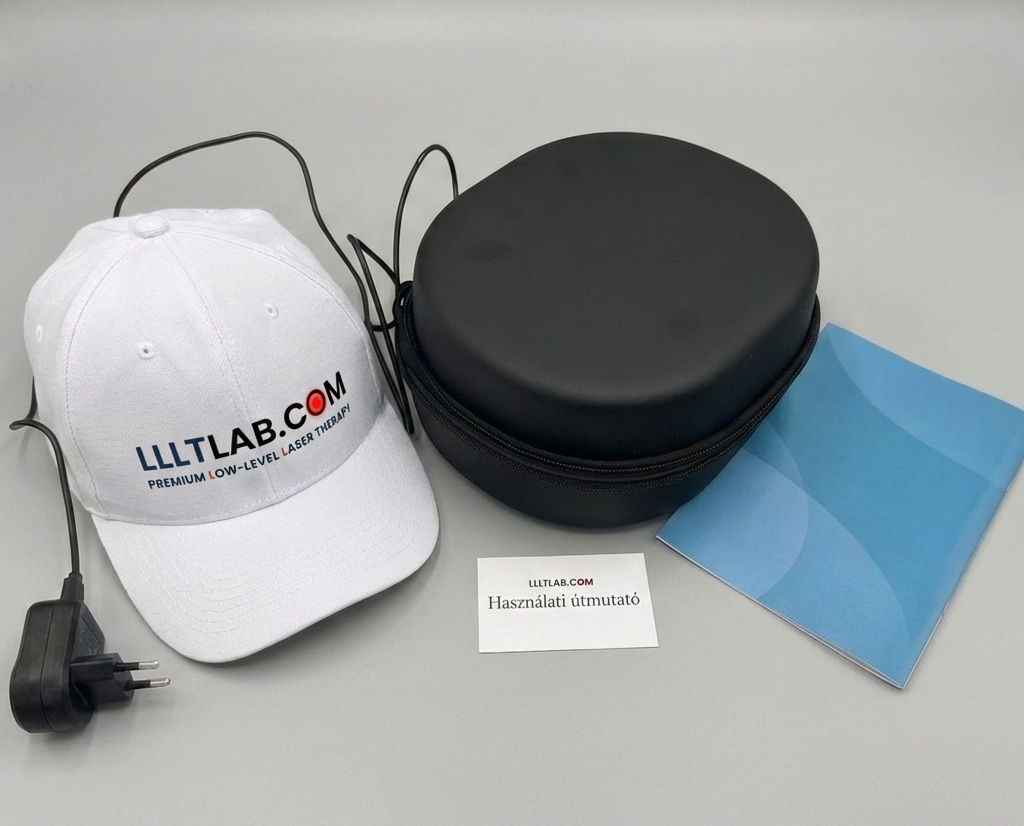
Size and use
What to know about wearing the cap
Two sizes
The inner circumference of the standard size is 58 cm, which matches the industry standard. If you need more room, choose the large size at 62 cm.
It fits most adult heads comfortably.
It does not need to be tight
A little space between your head and the cap is perfectly normal. The cap may shift slightly forwards and backwards.
This is not a fashion cap but a device designed for use at home.
💡 Tips for use
Sit comfortably
The cap is designed to be used while seated. Lean back and relax.
Sit upright
Put the cap on while sitting upright, and it will sit best.
30 minutes per session
That is the recommended session length, easy to fit into your day.
Any of them. The difference is the number of diodes, and therefore how much of the scalp is covered. Which one suits you depends on your budget and your needs.
Yes. If you are also using medication, discuss combined use with your doctor.
Trials commonly used protocols of three 30-minute sessions per week. Follow the instructions supplied with the device. Total daily use should not exceed three hours.
Use is painless. Mild warmth is normal. The cap is light and comfortable to wear.
In scientific studies, changes in hair growth were typically reported after twelve to sixteen weeks of regular use.
More diodes mean more of the scalp is covered. The devices used in trials generally covered a large area evenly.
Most published research is based on studies using low-level lasers. Laser light is more coherent and more directional than LED light.
The optical output power of one laser diode is 5 mW. That is the power of the emitted light, not the electrical consumption. The total optical peak power by model: 128 diodes 0.64 W, 208 diodes 1.04 W, 312 diodes 1.56 W. The device works in pulsed mode, so the average power is 41.6 per cent of that: 0.27 W, 0.43 W and 0.65 W.
With outer dimensions of roughly 165 × 190 mm, the irradiated area of the 312-diode cap is about 246 cm². The device works in pulsed mode with a duty cycle of 41.6 per cent, so the average power is 0.65 W. That corresponds to about 2.6 mW/cm² average power density, and the energy dose of a 30-minute session is about 4.75 J/cm². For the other models: 208 diodes 3.17 J/cm², 128 diodes 1.95 J/cm². This is a figure calculated from the manufacturer's data, not a measurement. The actual dose is lower, because some light escapes at the edge of the cap and some is absorbed by the hair. For comparison, published studies of similar devices reported doses of roughly 2.9 to 4.2 J/cm² per session.
650 ± 10 nm, meaning the diodes emit between 640 and 660 nm. This is recorded in the laser safety test report. Most LLLT studies on hair were carried out in the same red range, between 630 and 680 nm.
Pulsed. According to the manufacturer's data the device runs at 6.94 Hz with pulses of 60 milliseconds, which is a duty cycle of 41.6 per cent. The diodes are therefore lit for about 42 per cent of the session. This is common for devices with many diodes and limits peak current and heating.
The cap comes in two sizes: standard with an inner circumference of 58 cm, and large at 62 cm. That matches the industry standard. The cap does not need to be tight; a little room at the sides is fine. It is a device for use at home, not a fashion cap. Put it on while sitting upright.
Technology examined in scientific studies
Low-level laser therapy has been examined in numerous clinical and observational studies. The figures below summarise observations from published research.
over 16 weeks
in an analysis of 1,383 people
in clinical trials
in published reviews
Why our laser cap?
We went through the scientific literature and the devices available on the market. Ours uses laser diodes only.
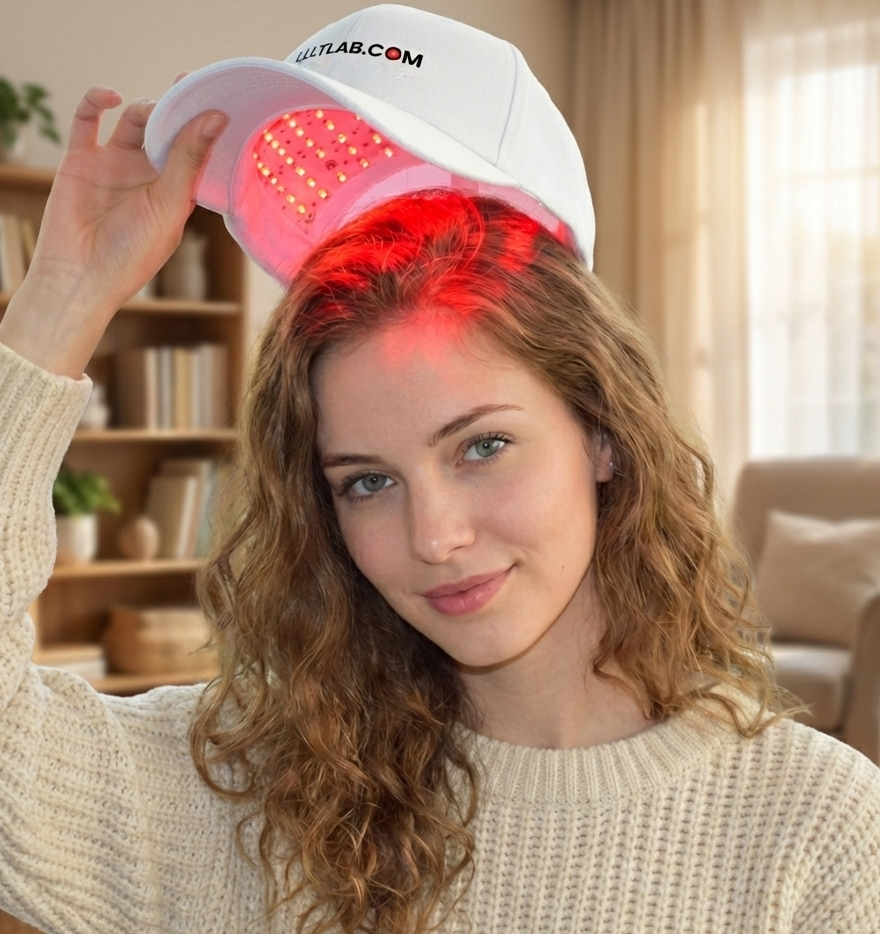
Real laser diodes, no tricks
Most published research was carried out with laser light. That is why our caps use laser diodes only, with no LEDs.
30-minute session
Clinical studies generally used protocols of 20 to 30 minutes. We set the session length accordingly.
Laser diodes only, no LEDs
Every diode is a genuine laser diode. There is a marked difference between LEDs and lasers in the coherence and focus of the light.
Tested and documented
The device complies with the RoHS Directive, which ensures the electronics contain no restricted substances above the limits, such as lead, mercury or cadmium.
Studied wavelength
The wavelength most often studied in the literature, and the one used in most peer-reviewed papers.
We went through the research and took our lead from it on wavelength, diode count and session length.
What sets our device apart
A comparison with devices available on the market.
| Feature | Typical market device* | Our laser cap |
|---|---|---|
| Ár | approx. EUR 2,000 to 2,400 | approx. EUR 300 to 580 |
| Number of diodes | fewer than 300 | 128 / 208 / 312 diodes |
| Technology | mix of LED and laser | laser diodes only |
| Session length | switches off after 6 minutes | 30 minutes |
| Origin | manufacturer not stated | manufacturer and EU representative stated |
| Warranty | 30 days or none | 2-year legal guarantee |
* The comparison is based on publicly available market information and manufacturers' specifications (as of 6 January 2026).
Documented testing
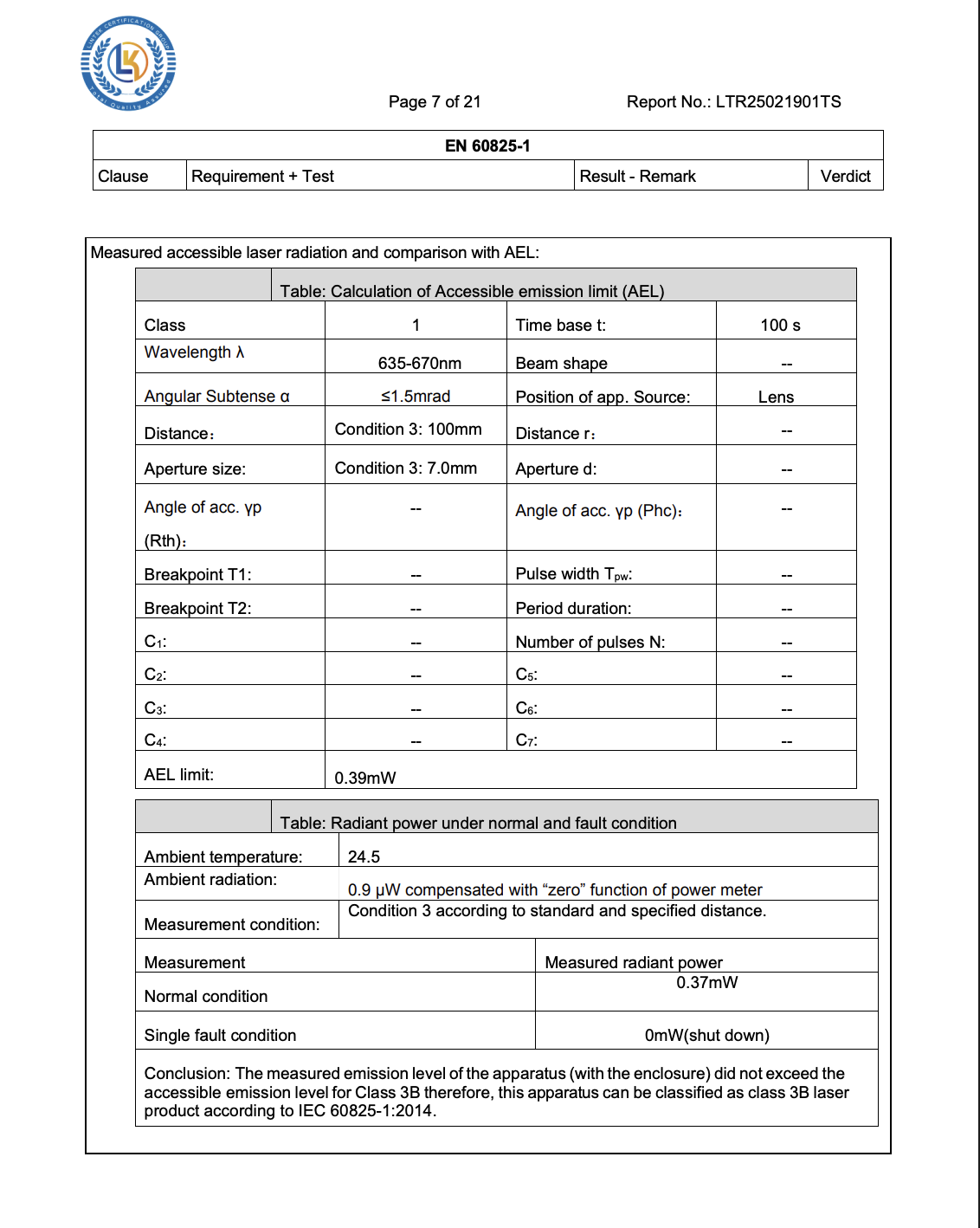
Test reports and conformity documents are held for our device.
EMC compliance
Tested to EN IEC 55014-1 and 55014-2
Tested to IEC/EN 60825-1
The laser safety assessment was carried out to IEC/EN 60825-1.
RoHS compliance
Meets the EU limits for restricted substances
Studied wavelength
650 nm, the range most often studied in the literature
Construction
Light, ergonomic and comfortable to wear
Non-invasive
No needles. Low-level laser technology for external use
Conformity
Which rules the device complies with
The cap is placed on the market with CE marking. Compliance with the rules below is declared by the manufacturer in an EU declaration of conformity, which we hold as the distributor.
CE marking is the manufacturer's declaration that the product complies with the European rules that apply to it. EMC testing checks that the device does not interfere with other equipment and is itself immune to interference. RoHS checks that it contains no restricted substances above the limits. EN 50689 is the separate standard for laser products intended for consumer use.
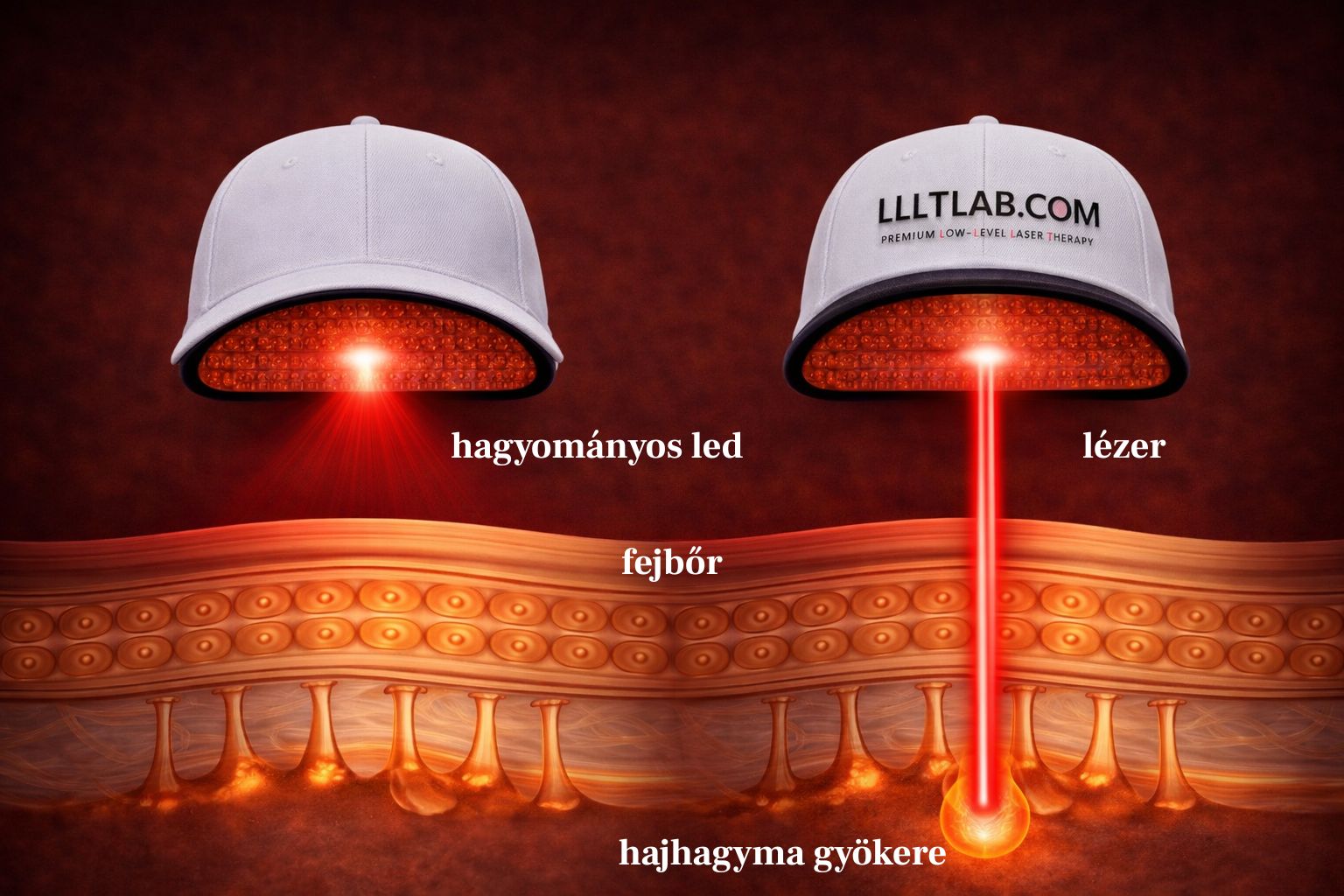
Laser or LED, what is the difference?
Conventional LED light mainly illuminates the surface of the scalp, whereas low-power laser light is more concentrated and penetrates further.
That is why most clinical studies were carried out with laser-diode devices, and why our devices use laser diodes only.
How does LLLT work?
Low-power laser light is directed at the hair follicles. What is studied are the biological processes linked to hair growth.
Microcirculation
Changes in the microcirculation of the scalp have been reported under red laser light.
Hair cycle
In scientific studies, LLLT has been linked to processes associated with the growth (anagen) phase of the hair.
Appearance of the hair
In clinical studies, regular use has been linked to observations concerning the density and thickness of the hair.
Nem csak a hajnak segít
A vörös fényterápiát világszerte számos tudományos területen vizsgálják. Az alábbi példák a publikált kutatások fókuszterületeit mutatják be, nem a jelen termék konkrét hatásait.
Kognitív működés
A vörös fényterápiát több tanulmányban vizsgálták az idegrendszeri működéssel összefüggésben. A kutatások célja annak feltárása volt, hogy a sejtszintű energiafolyamatok miként kapcsolódhatnak a kognitív teljesítménnyel összefüggő megfigyelésekhez.
„35 tanulmányból 29 esetében írtak le kedvező kognitív működéssel összefüggő megfigyeléseket."
ScienceDirect – Szisztematikus áttekintés →„A kognitív folyamatokkal összefüggő paramétereket egészséges egyéneknél is vizsgálták."
PMC – 2024-es áttekintés →Alvással, regenerációval összefüggő vizsgálatok
Egyes kutatások a fényterápia alkalmazását a szervezet regenerációs folyamataival, valamint az alváshoz kapcsolódó biológiai paraméterekkel összefüggésben elemezték kontrollált környezetben.
„Az alváshoz kapcsolódó paraméterek változását rövid távú vizsgálatokban elemezték."
Lasers in Medical Science – 2025 →„A regenerációval összefüggő mutatókat több napos vizsgálati időszakban követték."
PubMed – Randomizált vizsgálat →Általános közérzettel kapcsolatos megfigyelések
A vörös fényterápiát több kutatásban is a mentális közérzet, a relaxáció és a mindennapi stresszérzet összefüggésében vizsgálták. A technológiát sokan a kiegyensúlyozottabb közérzet és a mentális regeneráció támogatásának részeként említik.
„A pszichológiai jólléttel összefüggő megfigyeléseket kontrollált vizsgálati környezetben elemezték."
PMC – Klinikai vizsgálat →„A vizsgálatok során a stresszválaszhoz kapcsolódó mutatókat hosszabb időtávon követték."
PubMed – Neurológiai áttekintés →A vörös fényterápia sejtszintű hatásmechanizmusa miatt vált az egyik legszélesebb körben vizsgált, non-invasive technológiává. A jelen készülék hajápolási célú alkalmazásra készült.
Use at home
LLLT is also used in clinics. Since it has to be applied regularly, many people find use at home more practical.
Choose your model →What causes hair loss?
Understanding hair loss is the first step. Here are the causes in outline.
Hair loss in men
Main cause: DHT
Testosterone is converted into DHT (dihydrotestosterone), which shrinks the hair follicles. Hairs become finer and eventually fall out.
Genetic predisposition
The predisposition to hair loss is usually inherited on the mother's side. If your maternal grandfather was affected, the likelihood is higher.
Typical pattern
- Receding hairline at the temples
- Thinning at the crown
- An M-shaped hairline
- The areas gradually merge
Hair loss in women
Hormonal changes
Menopause, pregnancy, thyroid conditions and stopping the pill all affect hair growth.
Genetic predisposition
Genetics play a part in women too, though less predictably than in men. PCOS can also be a cause.
Typical pattern
- Diffuse thinning across the whole crown
- A widening parting
- Hair becoming finer overall
- Complete baldness is rare
Other causes
Iron deficiency, stress, severely restricted eating and autoimmune conditions can also cause hair loss in women.
Where does LLLT act?
LLLT does not act on DHT metabolism, but is directed at biological processes around the hair follicles. Red laser light has been linked to the microcirculation of the scalp and to ATP production in cells.
This may make the environment around the follicles more favourable. Scientific studies have reported observations concerning the appearance, density and quality of the hair. LLLT is a widely used, non-invasive technology that combines well with other methods.
10% off and free shipping
Subscribe and save
You are subscribed.
Here is your code:
We have sent you the guide by email as well.
We use cookies
This site uses cookies to run the shop, to measure visits and to measure advertising. Without the cookies needed to run the site, the cart and checkout will not work. The rest is your choice. Privacy policy
Needed for the cart, signing in and secure payment. The shop cannot be used without them.
Anonymous data on how many visitors look at what. It shows us what is worth improving on the site.
For measuring and personalising ads. You will still see ads without this, they will just be less relevant to you.